
 +91 9740503344
Mutual funds pool money from its unit holders and invests that money into a variety of securities, including stocks, bonds, and money-market instruments. This represents a way of investing money into a professionally managed and diversified pool of securities that hopefully will provide a good return on unit holders’ money.
The primary role of mutual funds is to assist investors in earning an income or building their wealth, by participating in the opportunities available in the securities markets.
Mutual funds address differential expectations between investors within a scheme, by offering various options, such as dividend payout option, dividend re-investment option and growth option. An investor buying into a scheme gets to select the preferred option also.
The investment that an investor makes in a scheme is translated into a certain number of ‘Units’ in the scheme. The number of units multiplied by its face value is the capital of the scheme – its Unit Capital.
Types of Funds
- Open-Ended Funds:
Open-ended funds are open for investors to enter or exit at any time and do not have a fixed maturity. Investors can acquire new units from the scheme through a sale transaction at their sale price, which is linked to the NAV of the scheme. Investors can sell their units to the scheme through a re-purchase transaction at their re-purchase price, which again is linked to the NAV. - Close-Ended Funds:
These funds have a fixed maturity and can be bought and sold in a stock exchange.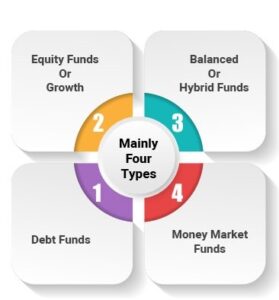
- Interval Funds:
Interval funds combine features of both open-ended and close-ended schemes. - Equity Funds:
A scheme might have an investment objective to invest largely in equity shares and equity-related investments like convertible debentures. The investment objective of such funds is to seek capital appreciation through investment in this growth asset. Such schemes are called equity schemes - Debt Funds:
Schemes with an investment objective that limits them to investments in debt securities like Treasury Bills, Government Securities, Bonds and Debentures are called debt funds. These debt securities are discussed in Chapter8. - Hybrid Funds:
Hybrid funds have an investment charter that provides for investment in both debt and equity. Some of them invest in gold along with either debt or equity or both.
This is a simple strategy for accumulating wealth over a period of time by investing regularly at a fixed interval of time in mutual fund schemes, this is similar to the concept of recurring deposits scheme, but this being in equity come tagged with relatively a higher risk and higher return than the recurring deposit.
What is Systematic Investment Plan?
An investor commits to invest a specific amount for a continuous period at regular intervals, this ensures that he gets more units when prices are lower and fewer units when prices are high, this works on the principle of rupee cost averaging when invested at different levels and automatically participate in the swing of the market.
Advantages of Systematic Investment Plan:
Power of Compounding, To avail the benefit of power of compounding one has to start early and invest regularly, a delayed investment will lead to greater financial burden to meet the required goals, at early stage a less investment needed where as more investment is needed at a later stage to accumulate the same planned corpus.
Rupee-Cost averaging:
It means averaging the cost price of your investments.
SIP helps in averaging the cost as equal amount is invested regularly every month at different NAVs. SIP works well in a volatile market as in the months where markets are down you get more number of units as the NAV is down and when the markets are up you get less number of units. But over all the prices gets averaged out.
Let us see how: Say you make your first investment of Rs 1,000 at a NAV of Rs 10. In this case, the units acquired will be 100 (1,000/10). You make the next investment of Rs 1,000 at a NAV of Rs 12. Units acquired now will be 83.33333 (1,000/12). Now also suppose that you make the third investment of Rs 1,000 at a NAV of Rs 9 and the units acquired will be 111.1111 (1,000/9).
The average purchase cost works out to Rs 10.19 (3,000/294.4444).
Convenience:
It is very easy to start an SIP, you need to plan your saving wisely and keep aside some amount of money every month for investing in funds, investment can be done either by post dated cheques or through ECS instructions in specific fund house scheme, its always better to start at an early age with small amount and increase the same from time to time. If you have not invested yet, start now without any delay, waiting for the right time to invest can lead to missed opportunity, a Systematic Investment Plan (SIP) is a smart way to achieve your various financial goals and ensures you with the required corpus which was initially planned for the specific requirement.
One can take the benefit of SIP only, when you choose the right schemes and be faithful and continue to stick to it, without any deviations.
SIP investment in well diversified and good performing scheme that can provide financial solutions to your long term goals like child education, marriage and your retirement.
An investment of Rs.2000 every month for the next 15 years at 15% return per annum can fetch you Rs.12,32,731 at the end of 15th year (solution for your child education).
An investment of Rs.3768 every month in the next 20 years @ 15% return per annum can fetch Rs.50 lakhs at the end of 20th year. This could be the solution for your retirement.